The Metered Channel: Why China Closed the Cross-Border Brokers

Forget the debate over how open or closed China's capital account is. The question that pays is meterability: can the state see a given channel, size it, and switch it off? A channel for money to cross China's border survives on that one condition. Read each cross-border action through it, and most of them stop being surprising.
The move that looks like a crackdown
Take the action that prompted this piece. On May 22 the securities regulator and seven other agencies issued a plan to comprehensively rectify illegal cross-border securities, futures, and fund activity. The same day, cases opened against three offshore-facing brokers: Futu faces around 1.85 billion yuan in fines and confiscation, Tiger around 411 million yuan, and Longbridge a confiscation-and-fine order, with a 1.25 million yuan personal penalty on each founder or chief executive. Combined, the three exceed 2.2 billion yuan. The shares fell sharply.
The headline reads as a sudden crackdown. Under the metered-channel test it is something calmer and more predictable: the state closing a channel it could not meter.
The plumbing had been signaling for years. The central bank first labeled these platforms "unlicensed driving" in 2021. New mainland onboarding was barred in 2022. The apps left domestic stores in 2023. The firms spent 2024 and 2025 running down their mainland books, and Futu's mainland clients were down to 13 percent of its total by the first quarter of 2026. May was the last step, not a surprise. What disqualified these brokers was the route. The money moved outside the state's line of sight, where it could not be seen, sized, or stopped.
Twenty years of building the opposite
Set the enforcement against what China has been building for two decades, and the pattern resolves into one line. Channel by channel, the state has assembled a lattice of compliant, quota-bound, state-visible conduits: the qualified-investor scheme from 2002, Stock Connect in 2014 and 2016, Bond Connect northbound in 2017 and southbound in 2021, Swap Connect in 2023, interbank bond repo opened to foreign investors in 2025, and the Cross-Border Wealth Management Connect in 2021 and 2024. Each is metered: a defined quota, a visible route, an off switch.
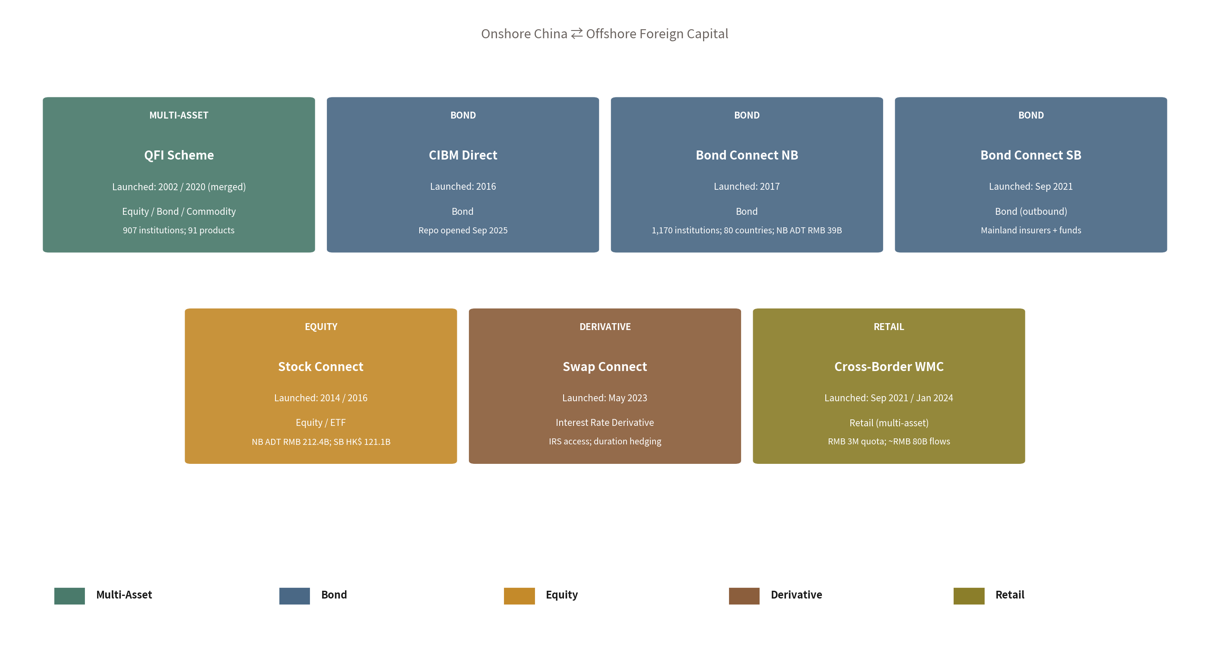
Figure: China's compliant cross-border channels, by asset class and launch year. Source: Inside China's Financial Markets (2026 Edition), Figure 10.1
Seen this way, the broker enforcement is the mirror image of that opening. As the governable channels mature, the ungoverned ones are closed. The brokers were the last large retail conduit operating outside the lattice.
The reason sits in the structure of a managed capital account. China wants inbound capital and a more widely used currency, but it also wants control of the exchange rate and of the pace at which money leaves. Those aims pull against each other. Meterability is how the state holds them together: build channels it can throttle, and money can cross without the state losing its grip on volume and direction. An unmetered pipe surrenders that grip, so it cannot be allowed to scale.
The same logic shows in how the May action was run. The wind-down runs two years, from May 2026 to May 2028, and existing clients may sell or transfer out but not buy or transfer in, with their assets protected. It is coordinated across the system: the securities regulator leads case handling, the cyberspace administration clears illegal accounts, the industry ministry pulls the apps, the market regulator pursues illegal advertising, the central bank and the foreign-exchange administration police cross-border funds and underground banking, and public security handles the criminal track. A state closing a channel it cannot meter dismantles it on a schedule and routes the demand elsewhere.
And it does route it. The quiet beneficiaries are the metered channels themselves: Stock Connect Southbound, the qualified-investor, and the Cross-Border Wealth Management Connect, each positioned to absorb the redirected demand, with Hong Kong's regulator tightening look-through checks on mainland account openings. Demand for cross-border access simply shifted onto rails the state can read.
How to read the next move
This is what makes the metered channel worth keeping as a lens rather than a one-time read. Opening tells you where access is being widened and which rails will carry the flow. Closing tells you which unmetered route ran out of room.
Across twenty years, China has run the same doctrine: consolidate cross-border access into instruments it can meter. Once you can see the channel, you can read the move.
The full channel map and the regulatory architecture behind it are in Chapter 10 of the handbook, Inside China's Financial Markets:A Practitioner’s Guide to Regulation, Banking, Bonds, Equities & Beyond.